GoHighLevel vs HubSpot for Small Sales Teams in 2026
For most small sales teams in 2026, HubSpot is the safer fit when you need a cleaner CRM, stronger reporting, and easier team adoption, while GoHighLevel fits better when the business also needs funnels, lead capture, and agency-style automation in one stack.
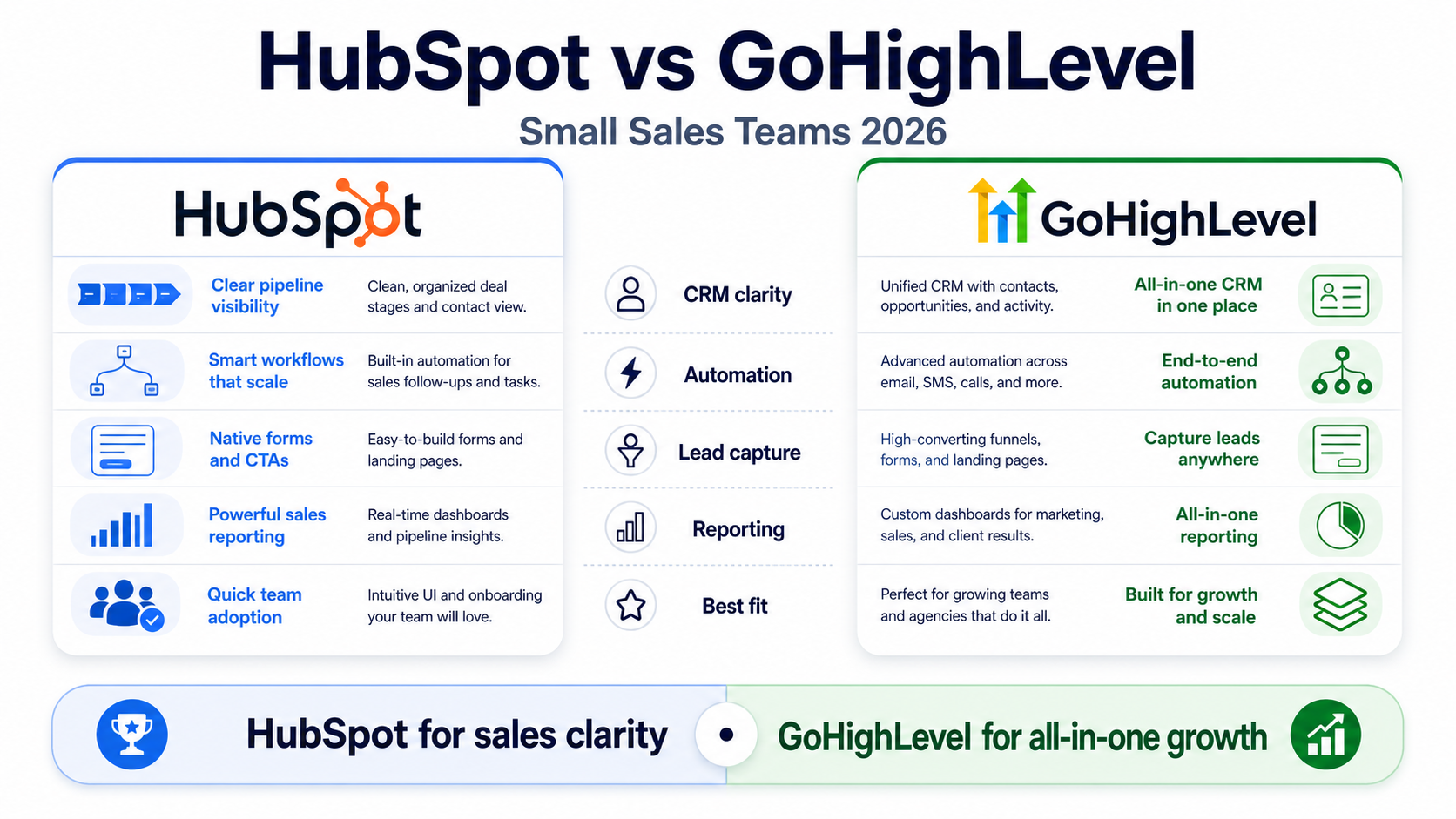
Visual summary: This summary graphic shows the article's core decision: HubSpot is usually stronger for small sales-team clarity, while GoHighLevel is stronger when CRM, funnels, and automation need to live together.
Compare CRM Options →
Most small sales teams comparing GoHighLevel and HubSpot are not choosing between two equal CRMs. They are choosing between a cleaner sales-operating system and a more all-in-one funnel-heavy growth stack. The right choice depends on whether the next bottleneck is sales-team clarity or lead-capture and automation breadth.
Quick Answer
Choose HubSpot if your small sales team mainly needs pipeline visibility, reporting, follow-up discipline, and a CRM that new reps can understand quickly. Choose GoHighLevel if the team also needs landing pages, forms, automations, and lead-capture workflows bundled closer together. For most small internal sales teams, HubSpot is the better default. For lean operators who want CRM plus funnel execution in one place, GoHighLevel can be the better value.
Key Takeaways
- HubSpot is usually easier for small sales teams that care most about CRM clarity and rep adoption.
- GoHighLevel is stronger when lead capture, funnels, and automation matter as much as the CRM itself.
- The real choice is whether you need a sales system first or a broader revenue stack first.
Decision Summary
- Pick HubSpot for cleaner sales visibility, reporting, and onboarding for small teams.
- Pick GoHighLevel when you need CRM plus lead forms, funnel pages, and heavier automation in one operating stack.
- If your bottleneck is rep execution and pipeline management, HubSpot usually wins. If your bottleneck is stitching together lead flow and follow-up, GoHighLevel can win.
Who should compare GoHighLevel and HubSpot right now
This comparison matters for small sales teams losing time in scattered follow-up, weak pipeline visibility, or a messy handoff between marketing and sales.
In 2026, the choice is usually between better sales discipline and better lead-flow consolidation. HubSpot is the cleaner sales-system choice, while GoHighLevel is more attractive when pages, forms, automations, and CRM need to sit under one roof.
Where HubSpot wins for small sales teams
- Cleaner pipeline views and easier rep onboarding.
- Better fit when multiple team members need visibility and structure.
- Stronger reporting and less operational confusion for internal sales teams.
HubSpot usually wins when the sales process needs clarity more than novelty. It is easier for small teams that need accountability, forecast visibility, and a repeatable rep workflow.
Once multiple reps touch the pipeline, simplicity becomes a commercial advantage. A system that is easier to adopt often beats a richer system that the team only half-uses.
Where GoHighLevel wins
- More attractive when forms, landing pages, and automation need to sit closer to the CRM.
- Good fit for operators who want an all-in-one stack instead of stitching tools together.
- Useful when lead capture and nurture are as important as opportunity tracking.
GoHighLevel is stronger when the team needs a tighter capture-to-follow-up machine with landing pages, forms, booked calls, and automation feeding directly into the pipeline.
For lean teams, the appeal is fewer moving pieces and a shorter route from lead to next action, not necessarily best-in-class depth in every feature.
The real decision is sales discipline versus stack consolidation
A lot of software comparisons stay too shallow by listing features in isolation. That is not enough here. The deeper question is what kind of operational improvement you are trying to buy. If the team is already generating leads and mostly needs better rep discipline, visibility, and reporting, HubSpot is usually the cleaner answer. If the team keeps leaking leads before the pipeline even becomes trustworthy, GoHighLevel's broader operating surface can be more useful.
The better tool is the one that shortens the next revenue bottleneck. For some teams that means a CRM reps will actually update. For others it means getting forms, automations, booked-call flow, and pipeline movement into one tighter system. Teams that know which bottleneck matters most usually make the cleaner choice faster.
What most small sales teams should choose in 2026
If the business has multiple reps and needs cleaner pipeline management, HubSpot is usually the safer recommendation. If the operator needs one stack to move leads from form or funnel into follow-up, GoHighLevel can be the better fit.
Recommended Next Step
If this is your decision right now, the best next move is not more generic CRM browsing. It is to compare adjacent buying questions that sharpen what matters most in your stack.
- Review the broader field: Best CRM Pipeline Software in 2026.
- If pricing and funnel logic matter, compare ClickFunnels vs GoHighLevel in 2026.
- If you want the small-business CRM angle, review Best CRM Software for Small Business in 2026.
FAQ
Is GoHighLevel or HubSpot better for a small sales team in 2026?
HubSpot is usually better for small internal sales teams that need cleaner CRM visibility and easier rep adoption. GoHighLevel is better when CRM, funnels, and automation need to be combined more tightly.
Should a small sales team choose an all-in-one platform or a cleaner CRM?
Choose the cleaner CRM if the main bottleneck is rep execution and pipeline visibility. Choose the all-in-one route if the bigger problem is moving leads from capture into follow-up without stack sprawl.
Is GoHighLevel mainly for agencies?
It is agency-friendly, but lean operators and small teams can still benefit when they need CRM plus automation and lead capture in one stack. The question is whether that breadth solves a real bottleneck for the team.